By Roger Crowley.
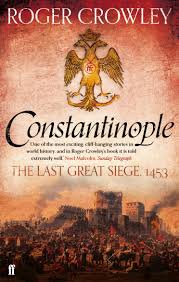
The fall of Constantinople in 1453 signaled a shift in history and the end of the Byzantium Empire. Roger Crowley’s readable and comprehensive account of the battle between Mehmet II, sultan of the Ottoman Empire, and Constantine XI, the 57th emperor of Byzantium, illuminates the period in history that was a precursor to the current conflict between the West and the Middle East.
For a thousand years Constantinople was quite simply “the city”: fabulously wealthy, imperial, intimidating – and Christian. Singlehandedly it blunted early Arab enthusiasm for Holy War; when a second wave of Islamic warriors swept out of the Asian steppes in the Middle Ages, Constantinople was the ultimate prize: “The Red Apple.” It was a city that had always lived under threat. On average it had survived a siege every forty years for a millennium – until the Ottoman Sultan, Mehmet II, twenty-one years old and hungry for glory, rode up to the walls in April 1453 with a huge army, “numberless as the stars.
The book covers the story of the last siege of Constantinople by the Ottomans. The book switches between what’s going on inside the city with the Emperor Constantine imploring the West for help, and the Ottomans camps and their preparation and ultimate attack.
The fighting takes place on land and sea, and underground using mines to get past the city walls.
Based mostly on Christian sources as the author states, there aren’t many Islamic ones. The book is a great portrayal of the siege and the plotting of the defenders and the attackers. Religion and prophecy hangs over it all.
Very informative and quite fast paced the author does a great job of giving a sense of tension/desperation of it all.